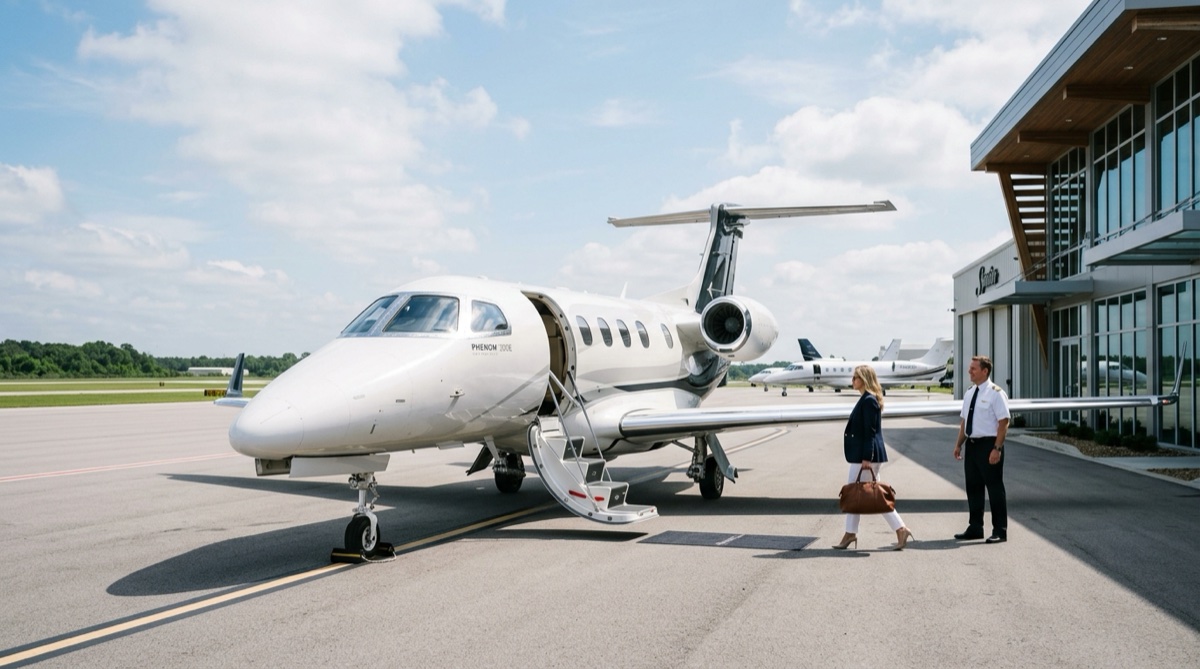
7 Best Light Jets for Short-Range Private Flights in 2026
Light jets deliver private aviation’s best value per mile — and in 2026, the category has never been more competitive.
What You’ll Learn:
- The 7 best light jets ranked by real-world performance and charter value
- Key specs compared: range, speed, seats, and cabin dimensions
- Charter cost benchmarks for each aircraft in 2026
- Which light jet fits which route type and passenger group
- How to use empty legs to fly light jets at a fraction of charter rates
Light jets occupy the sweet spot of private aviation. They’re fast enough for regional routes, economical enough to charter without a boardroom budget, and comfortable enough to arrive ready to work. On routes under 1,800 nautical miles — New York to Miami, London to Geneva, LA to San Francisco — a light jet beats both very light jets and midsize jets on cost-per-seat-mile.
The category has also evolved significantly. The Cessna Citation CJ4 Gen3 entered service in 2026 with Garmin Emergency Autoland technology. The Embraer Phenom 300E just logged its 13th consecutive year as the world’s best-selling business jet, according to NBAA delivery data. And the Pilatus PC-24 has carved out a loyal following among operators who need runway flexibility that no other light jet can match.
This guide compares the seven best light jets by range, cabin, charter cost, and best-fit use case — so you know exactly which aircraft to request on your next booking.
How We Ranked These Aircraft
We evaluated each aircraft on five criteria:
- Range: Maximum range in nautical miles (NBAA IFR reserves, 4 passengers)
- Speed: Maximum cruise speed in knots
- Cabin comfort: Width, height, and volume; stand-up capability
- Charter value: 2026 hourly charter rate relative to what you get
- Versatility: Single-pilot certification, runway requirements, cargo capability
We focused on aircraft currently in active charter service — not concepts or pre-order announcements.
The 7 Best Light Jets in 2026
1. Embraer Phenom 300E — Best Overall Light Jet
The Phenom 300E is the category benchmark for a reason. Embraer delivered 72 Phenom 300E aircraft in 2025, making it the most-delivered light jet for the 13th straight year. Its combination of 464-knot cruise speed, 2,010 nm range, and flat-floor cabin puts it ahead of nearly every competitor on any metric that matters for charter travel.
Key Specs
- Range: 2,010 nm
- Cruise speed: 464 knots (Mach 0.78)
- Passengers: 6–7
- Cabin height: 4’11” (1.50 m)
- Single-pilot certified: Yes
- Charter rate: $3,800–$5,200/hr
The Phenom 300E’s Garmin G3000 Prodigy Touch avionics suite, combined with its quiet Honeywell HTF7000 engines, creates a cabin environment that rivals midsize jets at a significantly lower operating cost. The flat floor is a differentiator at this price point — most competing light jets have a slight step in the aisle.
Best for: Business travelers, couples, and groups of up to 6 who want the fastest light jet on routes under 1,800 miles.
2. Cessna Citation CJ4 Gen3 — Best Range in Class
The Citation CJ4 has always been the range king of the light jet world. The Gen3 variant, which entered commercial service in 2026, pushes that further with updated avionics — including Garmin G3000 PRIME with Emergency Autoland — and a refined cabin. At 2,165 nm, the CJ4 Gen3 is the only light jet that can realistically consider a transatlantic crossing with a single fuel stop.
Key Specs
- Range: 2,165 nm
- Cruise speed: 451 knots
- Passengers: 7–10 (various configs)
- Cabin height: 4’9” (1.45 m)
- Single-pilot certified: Yes
- Charter rate: $3,000–$4,500/hr
The Gen3’s Emergency Autoland — the first Citation to feature it — uses Garmin’s automatic emergency descent mode to land the aircraft without pilot input. This safety feature is becoming a key selling point for risk-conscious charter clients and owner-pilots.
Best for: Range-priority missions where you want the ability to push a route to its limit without an unplanned fuel stop.
3. Pilatus PC-24 — Best Operational Flexibility
No other light jet does what the PC-24 does. Its ability to operate from runways as short as 2,900 feet — including unpaved grass, gravel, and dirt strips — opens destinations completely off-limits to conventional jets. Think ranch airstrips in Montana, private island runways in the Caribbean, or remote lodges in Patagonia.
Key Specs
- Range: 2,000 nm
- Cruise speed: 425 knots
- Passengers: 6–8
- Cabin height: 5’1” (1.55 m)
- Cargo door: Yes (standard)
- Charter rate: $4,200–$5,800/hr
The PC-24’s 501-cubic-foot cabin is the largest in the light jet segment by a wide margin. It also burns 38% less fuel per hour than the older Citation XLS+, which keeps operating costs surprisingly competitive for the cabin size it offers.
Best for: Operators and travelers who need access to remote or short-strip destinations without sacrificing cabin space.
4. HondaJet Elite II — Best Very Short Hops
Honda’s unconventional design — with over-the-wing engine mounts rather than tail-mounted engines — creates a rear cabin free of engine intrusion, giving the HondaJet Elite II the largest rear-cabin volume per fuselage width of any aircraft in the very light / light jet overlap category.
Key Specs
- Range: 1,100 nm
- Cruise speed: 422 knots (485 MPH)
- Passengers: 4–5
- Cabin height: 4’11” (1.50 m)
- Single-pilot certified: Yes
- Charter rate: $3,200–$4,200/hr
The Elite II’s range limits it to shorter hops — about the distance from New York to Chicago or London to Madrid. But within that envelope, it offers strong speed, a surprisingly refined interior, and a fully enclosed lavatory that most very light jets can’t match. Honda delivered 30–35 Elite IIs in 2025, demonstrating solid market uptake.
Best for: 1–3 passenger short-hop trips where lowest charter cost matters and flexibility in routing is less critical.
5. Cessna Citation CJ3+ — Best Entry-Level Light Jet
The CJ3+ is the most approachable jet in Cessna’s lineup. It’s a proven platform favored by owner-pilots and charter operators alike for its reliability, global service network, and predictable operating costs. The CJ3+ won’t win a speed or range contest against the Phenom 300E or CJ4, but it covers a wide majority of regional routes efficiently.
Key Specs
- Range: 1,875 nm
- Cruise speed: 416 knots
- Passengers: 7–8
- Cabin height: 4’9” (1.45 m)
- Single-pilot certified: Yes
- Charter rate: $3,000–$4,000/hr
The CJ3+‘s availability is one of its biggest practical advantages — it’s one of the most common light jets in the charter fleet worldwide. More aircraft means more scheduling flexibility and more competitive pricing when sourcing through a broker.
Best for: Travelers who want a proven, cost-efficient platform for routes up to 1,500 nm with flexible departure options.
6. Embraer Phenom 100EX — Best for Small Groups
The Phenom 100EX is the entry point to the Embraer family and one of the most efficient very light jets available. While technically in the VLJ category, its performance and cabin quality rival older light jets, which is why many operators and travelers consider it a light jet-adjacent option.
Key Specs
- Range: 1,178 nm
- Cruise speed: 390 knots
- Passengers: 4–5
- Cabin height: 4’9” (1.45 m)
- Single-pilot certified: Yes
- Charter rate: $2,800–$3,800/hr
The Phenom 100EX is the starting point for travelers moving from commercial first class into private. Its low hourly rate and wide charter availability make it a strong value option for 2–4 passenger trips on routes under 1,200 nm.
Best for: First-time private charter flyers and small groups wanting maximum value on short regional routes.
7. Beechcraft Premier I — Best Legacy Value
The Premier I isn’t the newest aircraft on this list, but it offers something rare at its charter price: a composite fuselage that gives it the widest cabin cross-section in the light jet category. If cabin width is your priority — and it often is on 2+ hour flights — the Premier I’s 5’6” interior width rivals many midsize jets.
Key Specs
- Range: 1,500 nm
- Cruise speed: 430 knots
- Passengers: 5–6
- Cabin height: 5’6” width (largest in segment)
- Single-pilot certified: Yes
- Charter rate: $2,500–$3,500/hr
The Premier I is a legacy platform and costs of maintenance can be higher than newer aircraft. Source it from operators with well-maintained examples. Its age works in your favor on charter pricing — lower rates than comparable-spec newer aircraft.
Best for: Passengers who prioritize cabin width and comfort on a fixed budget.
Light Jet Comparison Table: 2026 Specs and Charter Rates
| Aircraft | Range (nm) | Speed (kts) | Seats | Cabin Height | Charter Rate/hr | Best For |
|---|---|---|---|---|---|---|
| Phenom 300E | 2,010 | 464 | 6–7 | 4’11” | $3,800–$5,200 | Best overall |
| Citation CJ4 Gen3 | 2,165 | 451 | 7–10 | 4’9” | $3,000–$4,500 | Maximum range |
| Pilatus PC-24 | 2,000 | 425 | 6–8 | 5’1” | $4,200–$5,800 | Remote strips |
| HondaJet Elite II | 1,100 | 422 | 4–5 | 4’11” | $3,200–$4,200 | Short hops |
| Citation CJ3+ | 1,875 | 416 | 7–8 | 4’9” | $3,000–$4,000 | Fleet availability |
| Phenom 100EX | 1,178 | 390 | 4–5 | 4’9” | $2,800–$3,800 | Entry value |
| Premier I | 1,500 | 430 | 5–6 | 5’6” wide | $2,500–$3,500 | Cabin width |
Prices are estimates based on market data as of March 2026. Actual costs vary by operator, route, season, and aircraft condition.
Light Jet Charter Cost by Route: What to Budget
The chart above shows hourly rates, but your real cost depends on the trip distance and the all-in fee structure your operator applies.
| Route | Distance (nm) | Aircraft | Est. Charter Cost |
|---|---|---|---|
| New York → Miami | 1,090 | Phenom 300E | $14,000–$20,000 |
| LA → San Francisco | 330 | HondaJet Elite II | $6,000–$9,500 |
| London → Geneva | 430 | Citation CJ3+ | $10,000–$16,000 |
| New York → Chicago | 680 | Phenom 100EX | $9,500–$13,000 |
| Miami → Caribbean | 900 | Citation CJ4 Gen3 | $14,000–$21,000 |
| London → Nice | 740 | Phenom 300E | $13,000–$19,000 |
| LA → Las Vegas | 220 | HondaJet Elite II | $5,500–$8,500 |
Estimates include standard fees. Actual quotes depend on aircraft positioning and market conditions.
How to Fly Light Jets on Empty Legs
The smartest way to access a Phenom 300E or Citation CJ4 at a fraction of the normal charter rate is through empty leg flights. When a light jet drops off passengers and repositions empty, operators discount those flights 30–75% rather than fly zero revenue.
A Phenom 300E that costs $18,000 as a standard charter from New York to Miami might appear as an empty leg for $7,000–$10,000. The aircraft, crew, and safety standards are identical — the only difference is the fixed route and departure time.
Browse current empty leg listings on short-range routes — light jets make up the majority of available inventory on popular corridors like New York-Miami, London-Geneva, and LA-Las Vegas.
💡 Pro tip: Set up route alerts for your most common city pairs. Empty legs on popular light jet routes appear and disappear within 24–48 hours.
How to Choose the Right Light Jet
Matching the aircraft to your specific route and group saves money and improves the experience. Here’s a simple decision framework.
By Group Size
- 1–3 passengers: HondaJet Elite II or Phenom 100EX — lowest charter rate, efficient cabin
- 4–6 passengers: Phenom 300E or Citation CJ3+ — best balance of comfort and cost
- 6–8 passengers: Pilatus PC-24 or Citation CJ4 Gen3 — largest cabins in the light jet segment
By Route Length
- Under 600 nm: Any aircraft on this list. Prioritize lowest charter rate.
- 600–1,200 nm: Phenom 300E, CJ3+, or Premier I. Range is comfortable for all.
- 1,200–2,000 nm: Phenom 300E, CJ4 Gen3, or PC-24. Don’t compromise on range here.
- Over 2,000 nm: You’re at the edge of the light jet envelope. Consider a super midsize or heavy jet for this mission.
By Destination Type
- Major FBOs and airports: Any aircraft. The Phenom 300E and CJ4 are usually most available.
- Short runways or grass strips: Pilatus PC-24 only. Nothing else in this category qualifies.
- Remote destinations with equipment: PC-24 with cargo door. Essential for adventure travel and medical transport.
Pro Tips for Booking Light Jets
- ✅ Ask for the specific tail number before booking. Aircraft condition varies significantly within the same model. A 2020 Phenom 300E flies differently from a 2016 model.
- ✅ Request the hourly rate and minimum flight time together. Most operators charge a 1.5–2 hour minimum even on 30-minute hops. This changes the math on short routes.
- ✅ Compare light jet and very light jet quotes for short routes under 400 nm. On sub-400 nm flights, a VLJ can save $2,000–$4,000 with nearly identical transit times.
- ✅ Use a broker for first bookings. Brokers source aircraft across multiple operators and often find you a locally positioned plane — eliminating repositioning fees.
- ✅ Check empty leg availability before requesting a standard charter. Popular light jet routes have frequent empty leg supply.
- ⚠️ Watch for the 4-hour rule on intercontinental hops. If the flight requires crew rest, total trip cost increases. Light jets aren’t designed for 6-hour+ legs.
- ⚠️ Confirm the Part 135 (US) or AOC (Europe) certification of the operator. Never fly on a non-certificated aircraft regardless of how favorable the price appears.
Frequently Asked Questions
What is the best light jet overall in 2026?
The Embraer Phenom 300E is the best overall light jet in 2026. It has held the title of world’s best-selling light jet for 13 consecutive years. Its combination of 2,010 nm range, 464-knot cruise speed, a flat-floor cabin, and single-pilot certification makes it the most versatile choice for both owner-operators and charter passengers.
What is the range of a typical light jet?
Most light jets have a range of 1,100 to 2,200 nautical miles. The HondaJet Elite II sits at the shorter end with around 1,100 nm, while the Cessna Citation CJ4 Gen3 leads the category at 2,165 nm. For context, 1,500 nm covers New York to Miami, Chicago to Los Angeles, or London to Rome nonstop.
How much does it cost to charter a light jet per hour?
Light jet charter rates in 2026 range from $3,200 to $5,500 per flight hour, depending on the specific aircraft, operator, and route. The HondaJet Elite II and Citation CJ3+ sit at the lower end of that range, while the Pilatus PC-24 and Phenom 300E command slightly higher rates due to their superior performance.
How many passengers can a light jet carry?
Most light jets carry 4 to 8 passengers in their standard executive configurations. The HondaJet Elite II seats 4–5, while the Pilatus PC-24 can hold up to 8 passengers in its high-density layout. Cabin sizes vary significantly — always confirm the actual passenger count with your charter operator for the specific aircraft.
What is the difference between a light jet and a very light jet (VLJ)?
Very light jets (VLJs) typically seat 3–5 passengers, have a range under 1,400 nm, and cruise below 400 knots. Light jets seat 5–8, have range up to 2,200 nm, and cruise at 400–465 knots. Light jets also tend to have wider cabins with more headroom, making them more comfortable for flights over 90 minutes.
Can a light jet fly coast to coast in the US?
The top-performing light jets can cover coast-to-coast routes with one fuel stop. The Citation CJ4 Gen3 (2,165 nm range) can fly New York to Los Angeles with a quick stop, and the Phenom 300E can do the same. Direct coast-to-coast in the US requires 2,400+ nm of range, which puts you into super midsize territory.
Is the Pilatus PC-24 considered a light jet?
The Pilatus PC-24 occupies a unique segment often called “super light jet.” Its cabin volume exceeds most midsize jets, yet its operating costs and charter rates align with the light jet category. It also operates from unpaved runways as short as 2,900 feet — a capability no other jet in this class matches.
What light jet has the most cabin space?
The Pilatus PC-24 offers the largest cabin in the light jet category at 501 cubic feet of volume. The Embraer Phenom 300E follows at 324 cubic feet. The PC-24 also features a cargo door, making it useful for operators who need to transport equipment alongside passengers.
The Right Light Jet Changes Everything
The difference between a mediocre private flight and a great one often comes down to aircraft selection. A group of six squeezed into a four-seat very light jet is a different experience entirely from a Phenom 300E with a flat-floor cabin and stand-up headroom.
For most regional routes — under 1,800 nm, groups of 2–7 passengers — a light jet is the correct tool. The Phenom 300E dominates on overall performance. The CJ4 Gen3 wins on range. The PC-24 solves the problem of remote destinations. And for entry-level value, the HondaJet Elite II and CJ3+ deliver a genuine private aviation experience without the super midsize price tag.
Understanding the full cost of private jet charter helps you see where light jets fit in the wider pricing spectrum. And if you’re new to flying private, our first-time private jet guide covers everything from FBO protocols to tipping etiquette.
Ready to book a light jet? Browse available empty leg flights on the most popular short-range routes, or contact our partner brokers for a full-charter quote tailored to your itinerary.
Prices are estimates based on market data as of March 2026. Actual costs vary by operator, route, aircraft availability, and season. Sources: NBAA Business Aviation Fact Book 2025, Embraer delivery data, Textron Aviation CJ4 Gen3 product specifications, EBAA European Business Aviation Monitor 2025.