Private Jet to Croatia: Dubrovnik & Split Summer Guide
The Adriatic’s walled cities, hidden islands, and superyacht harbors reward travelers who land private and step straight onto the water — your guide to flying private to Croatia.
What You’ll Learn:
- Which airports serve Croatia and why Dubrovnik and Split are the main gateways
- Real charter pricing from major European cities for summer 2026
- The best aircraft for each route, from light jets to ultra long range heavy jets
- How to find empty leg deals into Dubrovnik and Split and save 30–75%
- Insider tips on FBOs, slots, island transfers, and the best weeks to fly
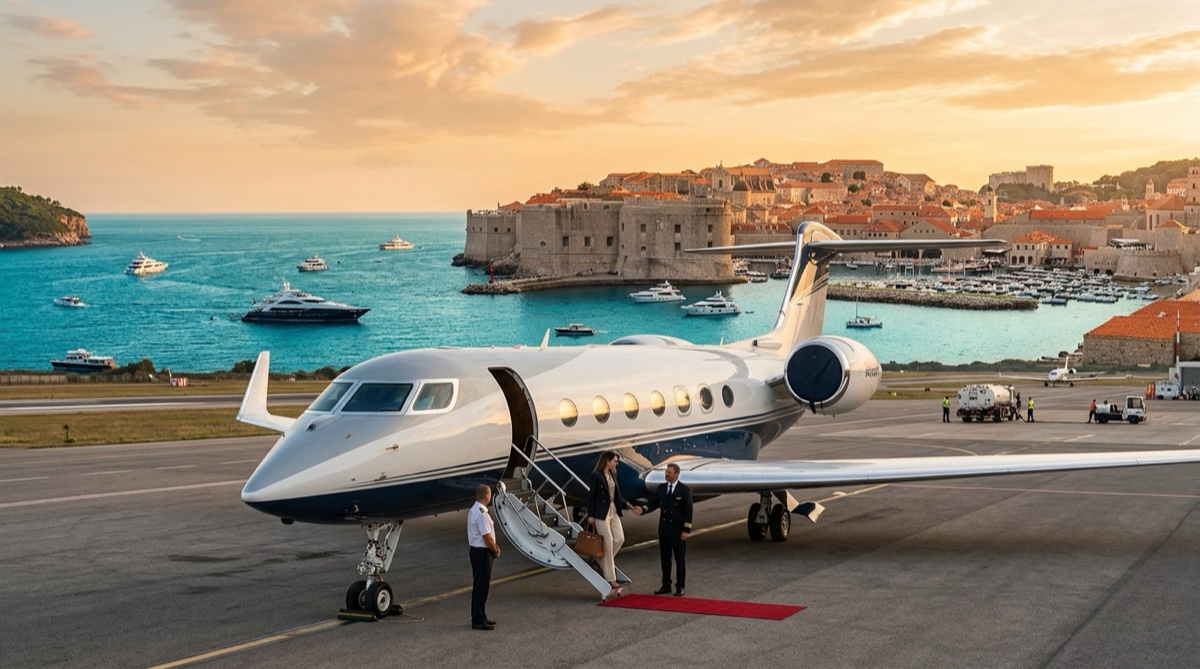
A private jet to Croatia is the fastest way onto the Adriatic, the stretch of walled cities, pine-covered islands, and clear water that now rivals the western Mediterranean for summer demand. Dubrovnik and Split fill each July and August with charter yachts, and the people aboard them rarely arrive by ferry. They land at DBV or SPU, clear customs in a private lounge, and reach their villa, marina, or island within the hour.
Croatia sits within easy nonstop range of every major European business aviation hub, which makes it efficient for midsize and super midsize jets. Both main airports also handle heavy jets without the runway limits that force transfers elsewhere in the region. This guide covers the airports, the routes, the pricing, and the practical details that separate a smooth arrival from a frustrating one.
Croatia Airports for Private Jets
Croatia has several airports along its long coastline, but private aviation traffic concentrates in the south and central Dalmatian coast, near the most-visited islands.
Dubrovnik (DBV / LDDU)
Dubrovnik is the gateway to the walled old town, the Elaphiti Islands, and the southern Dalmatian coast. Its 3,300-meter runway accepts the full range of business jets, from very light jets up to ultra long range heavy jets like the Gulfstream G650 and Global 7500. The airport sits in Čilipi, about 20 minutes by car from the old town and the Lapad and Babin Kuk hotel districts.
Split (SPU / LDSP)
Split serves central Dalmatia, including the Roman core of the city and the islands of Hvar, Brač, and Vis. A runway extension completed in recent years brought the main runway to roughly 3,160 meters, removing the old restrictions on larger jets. Split is the natural choice for travelers heading to Hvar or boarding a charter yacht in the central Adriatic.
Brač, Pula, and Zagreb
Brač (BWK) is a small island airport near Bol with a runway around 1,440 meters, suited to light jets and turboprops, and it is the closest airfield to Hvar by sea. Pula (PUY) serves Istria and the Rovinj and Brijuni areas in the north. Zagreb (ZAG) is the capital’s airport, used more for business travel than coastal leisure.
Best Routes to Fly Private to Croatia
Croatia’s position on the eastern Adriatic keeps flight times short from central Europe and Italy, and comfortably within nonstop range from the UK and France. The table below shows typical one-way summer charter estimates into Dubrovnik.
| Route | Distance (nm) | Flight Time | Midsize Jet | Super Midsize | Heavy Jet |
|---|---|---|---|---|---|
| Rome → Dubrovnik | 260 | 0h 55m | $9,500–$13,000 | $13,500–$18,000 | $19,000–$25,000 |
| Vienna → Dubrovnik | 350 | 1h 10m | $11,000–$15,000 | $15,500–$20,000 | $21,000–$28,000 |
| Munich → Dubrovnik | 470 | 1h 25m | $13,000–$17,500 | $18,000–$24,000 | $25,000–$33,000 |
| Geneva → Dubrovnik | 600 | 1h 40m | $16,000–$22,000 | $23,000–$31,000 | $33,000–$43,000 |
| London → Dubrovnik | 1,000 | 2h 30m | $26,000–$36,000 | $40,000–$55,000 | $58,000–$76,000 |
| Paris → Dubrovnik | 770 | 2h 05m | $22,000–$30,000 | $32,000–$44,000 | $47,000–$62,000 |
Prices are estimates based on market data as of June 2026. Actual costs vary by operator, route, and availability.
Short hops from Italy and central Europe
Rome, Venice, Vienna, and Munich are all under 90 minutes from Dubrovnik or Split. These short legs are the most affordable way to reach Croatia and a common source of empty legs, because operators shuttle aircraft between Italy, the Alps, and the Adriatic all summer.
Nonstop from the UK and France
London, Paris, and Geneva all sit within comfortable range of a super midsize or heavy jet. A Praetor 600 or Challenger 350 covers any of these nonstop with a full cabin, and the long runways at DBV and SPU mean no payload penalty on arrival.
Connecting from the Middle East and US
Because Dubrovnik and Split accept ultra long range jets at full weight, owners flying from Dubai, New York, or further afield can route directly to the Adriatic. A Global 7500 or Gulfstream G650 manages the Middle East nonstop and most US East Coast departures with a single efficient leg.
Charter Pricing for Croatia in Summer 2026
Pricing into Croatia follows the same summer curve as the rest of the Mediterranean, with a sharp late-July and August peak.
What drives the cost
Three factors move the number most: aircraft category, the day and week of travel, and repositioning. A Friday departure into Dubrovnik in early August costs far more than a midweek flight in June. If the aircraft has to fly empty to reach you, that ferry time is built into your quote. For a deeper breakdown of how these variables stack up, see our guide to private jet charter cost by route.
Empty legs into Dubrovnik and Split
Empty leg flights are repositioning trips sold at a steep discount when an operator needs to move an aircraft anyway. Croatia generates growing empty leg volume in July and August because so many jets fly in full and leave empty, or arrive empty to collect departing guests. Discounts of 30–75% off retail are common on the Vienna, Munich, Milan, and Geneva corridors. To understand how the savings work, read our explainer on how much empty leg flights cost.
Ready to book? Browse our latest empty leg deals → for current Mediterranean and central European repositioning flights into Croatia.
How Croatia compares to other summer hotspots
Dubrovnik and Split pricing sits slightly below Mykonos and Sardinia from the same departure points, partly because the central European corridors are shorter and busier. Like Sardinia, the long Croatian runways remove the heavy-jet restrictions that force helicopter transfers at smaller island airports elsewhere.
Best Aircraft for Flying to Croatia
The right aircraft depends on where you start and how many people travel with you.
Light and midsize jets for short legs
For hops from Rome, Venice, Vienna, or Munich with four to eight passengers, a Citation XLS+ or Phenom 300 is efficient and cost-effective. These aircraft handle Dubrovnik and Split comfortably and keep the bill down on routes under 90 minutes.
Super midsize for nonstop from the west
The Embraer Praetor 600 and Bombardier Challenger 350 are the workhorses of the London, Paris, and Geneva routes. Both carry eight to nine passengers nonstop with full luggage, and both offer the cabin width that makes a 2.5-hour flight feel effortless.
Heavy and ultra long range for intercontinental
The Gulfstream G650, Global 7500, and Falcon 8X turn Croatia into a direct destination from the Middle East and much of North America. The long runways at Dubrovnik and Split accept them at maximum landing weight, so there is no need to position in Rome or Vienna and continue onward.
On the Ground: Transfers and Island Access
The arrival experience is where Croatia earns its reputation. The FBO and handling agents at Dubrovnik and Split clear customs, immigration, and baggage in a private lounge, often in under 15 minutes. From there, the islands are close.
Getting to Hvar, Brač, and the Dalmatian islands
From Split or Brač, fast speedboats and helicopters reach Hvar, Brač, and Vis in 20 to 45 minutes. From Dubrovnik, the Elaphiti Islands and Korčula are a short tender or helicopter hop. For yacht charters, tender coordination and airside car-to-boat transfers are arranged through your handling agent, so you can be on deck within an hour of landing.
Concierge, hotels, and yacht support
Chauffeured cars reach the Dubrovnik old town in about 20 minutes and the Split waterfront in roughly 25. Luxury properties along the coast routinely meet guests at the aircraft, and yacht crews coordinate provisioning and boarding through the FBO. Croatia’s superyacht season runs in parallel with the jet season, so marina slots and tender windows should be confirmed alongside your flight.
Pro Tips for Booking a Private Jet to Croatia
- 💡 Book Dubrovnik and Split slots early for the first weeks of August; peak-week parking and runway slots fill fast.
- 💰 Target June or the second half of September for 20–35% lower charter rates and a calmer coast.
- ✈️ Use the Vienna, Munich, Milan, and Geneva corridors to catch the most frequent empty legs into DBV and SPU.
- ⚠️ Confirm whether your quote includes ramp parking; multi-day stays in peak season can add meaningful cost.
- ✅ Ask your broker about a one-way empty leg out of Croatia for the return; departing empties are common in late August.
Frequently Asked Questions
Which airport does a private jet use in Croatia?
Dubrovnik (DBV) and Split (SPU) handle the most private traffic. Dubrovnik’s 3,300-meter runway and Split’s 3,160-meter runway both accept heavy and ultra long range jets at full weight. Brač (BWK) serves Hvar and Bol with light jets, while Pula (PUY) and Zagreb (ZAG) cover Istria and the capital.
How much does a private jet to Croatia cost from London?
A one-way private jet from London to Dubrovnik in peak summer runs $26,000–$36,000 on a midsize jet and $40,000–$55,000 on a super midsize jet. The route is roughly 1,000 nautical miles and takes about 2.5 hours. Empty leg flights from London, Nice, or Vienna can cut costs by 40–70%.
Which aircraft is best for flying private to Croatia?
The Citation XLS+ and Embraer Praetor 600 are popular choices. The XLS+ handles short hops from Italy, Vienna, or Munich with eight passengers in comfort. The Praetor 600 covers London, Paris, and Geneva nonstop with full payload. Dubrovnik and Split also accept heavy jets like the Gulfstream G650 without restriction.
Can heavy jets like the Gulfstream G650 land in Croatia?
Yes. Both Dubrovnik (3,300 meters) and Split (3,160 meters) have long runways that accept heavy and ultra long range jets at full weight. Owners flying nonstop from the Middle East, the United States, or northern Europe land directly at DBV or SPU without needing to position elsewhere and transfer.
When is the best time to fly private to Croatia?
Mid-June through early September is high season, with late July and August the busiest and most expensive. The sweet spot is June and the second half of September, when the Adriatic is warm, the coast is calmer, and charter prices drop 20–35% versus the August peak. Book slots early for the first weeks of August.
Are there empty leg flights available to Croatia?
Yes, especially in July and August. Operators reposition aircraft constantly along the Mediterranean and central Europe, creating empty legs from Vienna, Nice, Milan, Munich, and Geneva into Dubrovnik and Split. Croatia is an increasingly active empty leg destination in summer. Check our listings weekly for last-minute deals at 30–75% off retail charter rates.
How do I get from the airport to Hvar or the islands?
From Split or Brač, fast transfers reach Hvar, Brač, and the central Dalmatian islands by speedboat or helicopter in 20 to 45 minutes. From Dubrovnik, the Elaphiti Islands and Korčula are reachable by tender or helicopter. Your handling agent coordinates airside car-to-boat transfers and yacht tenders directly from the FBO.
Do I need a visa to fly private to Croatia?
Croatia is part of the European Union and the Schengen Area. EU and EEA citizens need only a valid ID card. Most non-EU travelers use existing Schengen visas or ETIAS authorization. Your handling agent files the General Declaration before arrival, so customs and immigration usually clear at the FBO in under 15 minutes.
Conclusion
A private jet to Croatia is the most efficient way to reach the Adriatic at the height of its summer season. Dubrovnik and Split both carry long runways that accept heavy and ultra long range jets at full weight, so even guests arriving from the Middle East or North America land directly on the coast rather than transferring through another hub. The short legs from Italy and central Europe keep regional travel affordable, and the empty leg volume through those corridors creates genuine opportunities to save.
The variables that matter most are securing airport slots and parking early in peak August, choosing a runway-appropriate aircraft, and watching the empty leg market for both arrival and return. For broader context on summer routes across the continent, the European Business Aviation Association tracks movements throughout the region. Explore more options in our guide to the top private jet routes in Europe.
Ready to fly private to Croatia? Browse our latest empty leg deals → or request a charter quote → and our team will source the best aircraft and slot for your travel dates.
Published June 17, 2026 · Destinations · 11 min read