Private Jet Luggage Rules: What You Can Bring in 2026
Most people assume private jets work like commercial flights — long lines, strict weight limits, and a $35 fee to check a bag. None of that applies.
What You’ll Learn:
- How private jet luggage allowances differ by aircraft type
- Weight and size limits for light, midsize, and heavy jets
- Rules for sports equipment, pets, and oversized items
- What’s actually prohibited on private jets
- How to avoid luggage problems before your flight
Booking your first private jet flight comes with a lot of questions. One of the most common: “How much can I bring?”
The short answer: more than you think — but not unlimited. Private jets don’t have overhead bins or conveyor belts. Storage is built into the aircraft, and the amount varies significantly between a Cessna Mustang and a Gulfstream G700. A group of four squeezing onto a light jet for a weekend trip faces very different constraints than a couple flying transatlantic on a heavy jet.
Understanding the rules before you fly saves you from arriving at the FBO with two hard-shell suitcases that won’t fit in the tail cone — or paying for a larger aircraft than you actually need.
This guide breaks down everything you need to know about private jet luggage allowances in 2026, organized by aircraft type and situation.
How Private Jet Luggage Actually Works
There’s No Ticket Agent — But Limits Are Real
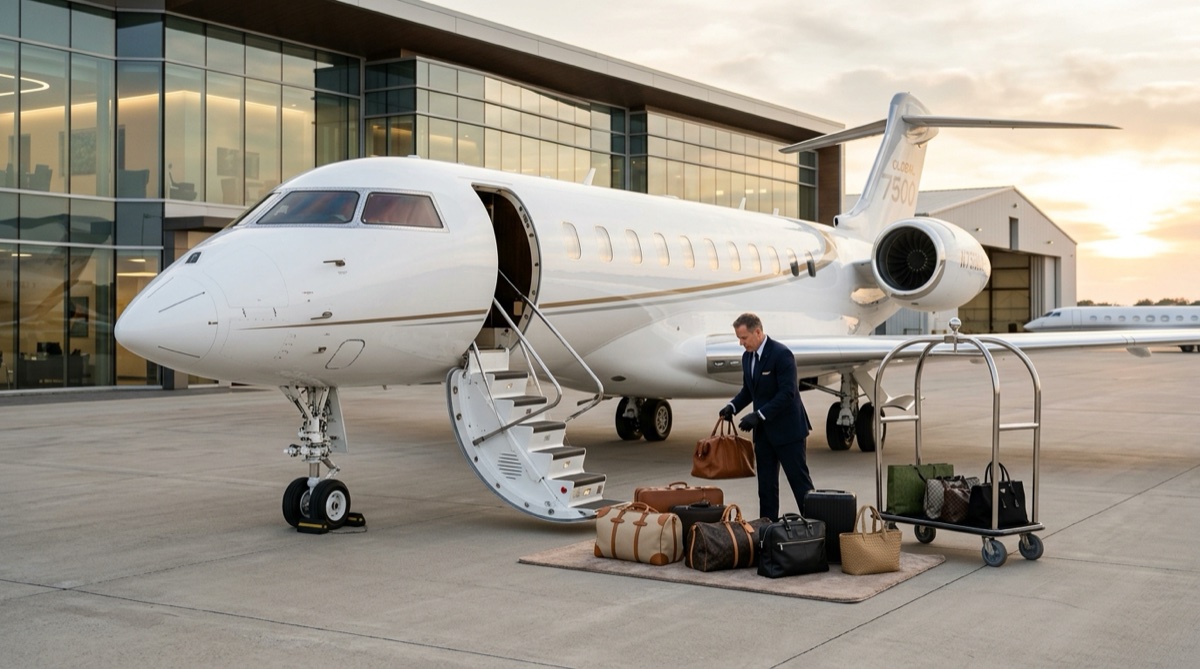
Private jets don’t check bags the way commercial airlines do. Your luggage goes directly into a dedicated baggage compartment — usually a tail cone or under-floor hold — without an X-ray belt or baggage fee counter.
But the limits are real. Every aircraft has a maximum takeoff weight (MTOW): the total weight the aircraft can safely lift, including passengers, crew, fuel, and luggage. When you add more people or more fuel (for longer routes), less payload capacity remains for bags.
The more passengers on your charter, the less each person can effectively bring. Your operator will confirm allowances at booking — but only if you ask or declare your luggage requirements. Don’t wait until you’re at the ramp.
Soft-Sided vs. Hard-Shell Bags
Smaller private jets have baggage compartments with irregular shapes. Soft-sided duffel bags and garment bags fit far better than rigid hard-shell suitcases. On a light jet, a large hard-shell Rimowa may simply not fit through the baggage door.
On heavy jets and ultra-long-range aircraft, this distinction doesn’t matter — the holds are large enough for any bag.
💡 Rule of thumb: If you’re flying on a very light jet or light jet, pack in soft-sided bags. Your operator will thank you, and your bags won’t get left at the FBO.
Luggage Allowances by Aircraft Type
Very Light Jets and Light Jets
Very light jets (VLJ) — the Cirrus Vision Jet, Cessna Citation Mustang — are designed for 4–6 passengers on short regional hops. Luggage space is limited almost by definition.
- Typical allowance: 40–60 lbs total for the flight
- Bag recommendation: Soft-sided duffels under 27 inches
- Realistic capacity: 2–3 carry-on-sized bags for the whole group
Light jets — the Phenom 300E, Cessna Citation CJ4, Learjet 40 — give you a bit more room:
- Typical allowance: 50–80 lbs total
- Bag type: Soft-sided bags strongly preferred
- Good for: Business day trips, weekend getaways with light packing
If you’re flying a full cabin with weekend bags, a light jet will feel tight. Consider this before booking.
Midsize Jets
Midsize jets — the Hawker 800XP, Citation XLS+, Learjet 60 — are the workhorse of business travel. Storage is more generous and accommodates standard luggage.
- Typical allowance: 60–100 lbs total
- Bag size: Standard 26-inch suitcases fit without issue
- Realistic capacity: 3–5 bags for a full charter
- Sports gear: Golf clubs usually fit; skis typically don’t for a full group
Super Midsize Jets
Super midsize jets — the Challenger 350, Citation Longitude, Falcon 2000 — offer a meaningful step up in cargo capacity alongside the longer cabin.
- Typical allowance: 100–150 lbs
- Bag size: Full-size luggage without concern
- Realistic capacity: 6–8 bags comfortably
- Sports gear: Golf bags fit; ski equipment for 2–3 passengers works with advance notice
Heavy Jets and Ultra-Long-Range Jets
Large cabin jets — the Gulfstream G450/G650, Falcon 8X, Global 6500, Bombardier Global 7500 — have proper luggage holds comparable to a small regional airliner.
- Typical allowance: 150–300+ lbs
- Bag size: Any luggage, any format
- Realistic capacity: 10–20+ bags depending on the aircraft
- Sports gear: Skis, golf clubs, bicycles — all accommodated with planning
On a Gulfstream G700 or Global 7500, luggage capacity is effectively a non-issue for most trips.
Luggage Allowance Comparison Table
| Aircraft Category | Example Aircraft | Approx. Weight Limit | Soft Bags Needed | Sports Gear |
|---|---|---|---|---|
| Very Light Jet | Citation Mustang, Vision Jet | 40–60 lbs total | Yes | ❌ Rarely |
| Light Jet | Phenom 300E, CJ4 | 50–80 lbs total | Yes | ❌ Limited |
| Midsize Jet | Citation XLS+, Hawker 800 | 60–100 lbs | Preferred | ✅ Golf clubs |
| Super Midsize | Challenger 350, Longitude | 100–150 lbs | No | ✅ Most gear |
| Heavy Jet | G450, Global 6000 | 150–250 lbs | No | ✅ All gear |
| Ultra Long Range | G700, Global 7500 | 250+ lbs | No | ✅ All gear |
Total allowances per flight, not per person. Actual limits vary by operator, route, fuel load, and passenger count. Prices and specs based on market data as of May 2026.
Sports Equipment and Oversized Items
Golf Clubs
Golf clubs are the most common oversized item private jet travelers bring. A single golf bag typically fits on a midsize jet if you’re flying with three or fewer passengers. For a foursome all carrying clubs, a super midsize or heavy jet is practical.
Always declare golf bags at booking. Your operator will confirm fit and position the bags correctly in the hold for weight distribution.
Ski Equipment
Ski gear — skis, poles, and boots — is bulkier and more rigid than golf bags. A midsize jet can handle skis for two passengers with lighter luggage elsewhere. A full group with ski equipment needs a super midsize or heavy jet.
Pack boots separately in a soft bag to save compartment space. Ski bags are long and often the limiting factor — not weight, but length.
Bicycles
Bicycles require coordination. Even folded, they take significant volume. A heavy jet with a dedicated hold is the realistic option. Many operators also offer cargo arrangement services for items that exceed the aircraft’s own storage — a car can be freighted separately, for instance.
Musical Instruments and Fragile Items
Private jets are frequently used to transport art, musical instruments, and fragile cargo. A cello or upright bass can occupy a passenger seat and be secured there for the flight. Large canvases and art pieces require advance coordination with your operator and FBO handling team.
For high-value or fragile items, ask your operator about cushioning requirements and whether any crating is needed for safe loading.
What’s Prohibited on Private Jets
What You Can Bring That Commercial Airlines Won’t Allow
Private jets are far more permissive than commercial aviation at TSA-screened terminals:
✅ Permitted on most private jets:
- Alcohol — wine, spirits, beer with no 3-1-1 restrictions
- Full-size toiletries and cosmetics
- Cigars (smoking policies vary by aircraft — confirm with operator)
- Food and catering without commercial restrictions
- Pets in the cabin
- Firearms (with proper documentation and operator approval)
- Oversized electronics — full camera setups, lighting gear
What Remains Off-Limits
Even on a private jet, certain categories are never acceptable:
❌ Always prohibited:
- Explosive devices and illegal weapons
- Hazardous materials beyond regulatory limits (certain lithium batteries, flammable compressed gases)
- Controlled substances (international customs screening applies regardless of aircraft type)
- Items banned by the destination country’s customs authority
For international flights, customs rules apply at the destination regardless of how you arrived. Flying private doesn’t exempt you from customs — it means you face individual inspection rather than crowd-based processing. High-value items, large quantities of cash, and agricultural products all carry standard reporting requirements.
According to the NBAA, private aviation operators are responsible for ensuring passengers and cargo comply with applicable regulations — including customs, agricultural, and security rules on international operations.
Firearms on Private Jets
US domestic private jet travel allows licensed firearm owners to transport unloaded weapons in secured hard cases. Operators must be notified in advance. Crew may request to verify the case is locked.
International firearms transport is complex. Rules vary dramatically by country — some nations ban civilian firearms entirely. Coordinate well ahead of your trip if this applies to you.
Flying With Pets on a Private Jet
Private jets are the most pet-friendly way to fly. Your dog or cat travels in the cabin with you — not in the hold, not under the seat in front of you, not in a pressurized cargo area.
Most operators welcome pets with:
- Advance notification at booking (always required)
- A cleaning fee of $100–$500 depending on the operator and aircraft
- Vaccination records for international travel
Large dogs — Great Danes, Mastiffs — may require specific seating arrangements to keep aisles clear. Multiple pets or exotic animals (reptiles, birds) require operator-specific approval.
For international pet travel, research destination country import rules well in advance. The UK, Australia, and New Zealand have some of the strictest pet import requirements in the world — quarantine periods and specific microchipping/vaccination timelines apply regardless of how you arrive.
Practical Packing Tips for Private Jet Travel
💡 What experienced private jet travelers actually do:
- Use soft duffels on light jets. They compress, reshape, and fit where hard cases won’t.
- Declare everything unusual at booking. Sports gear, pets, musical instruments, large quantities of wine — tell your operator upfront, not at the FBO.
- Distribute weight between bags strategically. Operators may redistribute luggage in the hold for aircraft trim, especially on smaller jets.
- Pack a small cabin bag for easy-access items. Most private jets have minimal cabin storage, but a small tote at your seat keeps valuables and electronics within reach.
- Check customs restrictions for international flights. Particularly for food, alcohol quantities, cash over $10,000, and any restricted goods.
- Ask the FBO about luggage handling. Most Fixed-Base Operators provide assistance loading and unloading. It’s a full-service environment — don’t lug bags yourself unless you want to.
- Consider freight for very large or heavy items. Some items are better shipped separately. Your operator or FBO can arrange cargo forwarding.
How Luggage Requirements Should Affect Your Aircraft Choice
Luggage needs can and should influence your aircraft selection. If you’re flying four passengers with ski equipment, you may need to upgrade from a light jet to a midsize — adding $800–$2,500 to the charter cost depending on the route.
Here’s a practical decision framework:
- 1–2 passengers, weekend bags, domestic route: Light jet handles it fine
- 2–4 passengers with standard luggage, no sports gear: Midsize jet is the right fit
- 4–6 passengers with golf or ski equipment: Super midsize or heavy jet
- Group of 8–12 with heavy luggage: Heavy jet, or consider splitting across two light jets (sometimes cheaper on popular routes)
When luggage requirements exceed what an aircraft can carry, always upgrade the aircraft — don’t ask the operator to squeeze it in. Weight distribution on smaller aircraft is a genuine safety consideration, not a formality.
Browse empty leg deals to find heavy and super midsize jets at reduced rates — particularly useful when your luggage requirements push you up a category from your original plan.
FAQ
How much luggage can you bring on a private jet?
It varies by aircraft size. Very light jets handle around 40–60 lbs total for the entire group — roughly 2–3 small soft bags. Light jets allow 50–80 lbs. Midsize jets manage 60–100 lbs. Heavy jets and ultra-long-range aircraft have minimal practical restrictions for most travelers. Always confirm with your operator at booking, since passenger count and fuel load affect the actual available space on any given flight.
Are there weight limits on private jets?
Yes. Every aircraft has a maximum takeoff weight (MTOW) that covers passengers, crew, fuel, and luggage combined. On short hops with a light jet, a full passenger load with heavy bags can push against limits. On longer flights, fuel weight takes priority. Your operator will identify any constraints before you arrive — weight problems are flagged at planning, not at the ramp.
Can you bring a pet on a private jet?
Yes — pets fly in the cabin with you on private jets, not in the hold. Most operators allow dogs, cats, and small animals with advance notice. Expect a cleaning fee of $100–$500. For international travel, check destination country import requirements well in advance. Some countries have strict quarantine or vaccination timelines that apply regardless of how you arrive.
Can you bring sports equipment on a private jet?
Yes, with planning. Golf clubs fit on midsize and larger jets. Ski equipment for a full group requires at least a super midsize jet. Bicycles and oversized sports gear require heavy jet hold space and advance coordination. Always declare sports gear at booking — your operator will confirm the fit and position bags to maintain proper aircraft trim.
Do TSA liquid rules apply on private jets?
No. The 3-1-1 liquid rule is a TSA commercial aviation requirement. At private FBO terminals, you don’t pass through TSA security checkpoints. You can bring full-size bottles, wine, spirits, and any legal liquids without restriction. International arrivals are still subject to customs inspection at the destination — those rules apply regardless of aircraft type or terminal.
Can you bring alcohol on a private jet?
Yes. Wine, spirits, beer, and other beverages are permitted without commercial airline restrictions. Many charters include bar service; others allow you to bring your own. For international travel, destination countries may have duty-free import limits — check before packing a case of wine in your hold luggage, as customs can confiscate quantities above the allowed threshold.
What happens if my luggage is too heavy for the aircraft?
Your operator will notify you before you arrive at the FBO — not after you show up. They may ask you to remove items, reduce the passenger count, or upgrade to a larger aircraft. At high-altitude airports or in hot weather, payload limits tighten due to reduced air density. Operators work with you to find a practical solution when luggage is declared honestly at booking.
Conclusion
Private jet luggage rules are more flexible than anything you’ve experienced on a commercial airline. No overhead bin battles, no $35 checked bag fees, no 3-1-1 liquid restrictions at most private terminals.
But limits do exist — and they vary significantly by aircraft. A light jet might max out at 80 lbs total. A heavy jet handles nearly anything you’d want to bring. Knowing your aircraft category before you pack prevents surprises on departure day.
The approach that works every time: tell your operator exactly what you’re bringing at booking. Sports equipment, pets, oversized items, large quantities of valuables — none of it is a problem when declared early. Operators build the flight plan around your payload. A conversation at booking takes two minutes. A mismatch at the FBO is a much bigger problem.
Ready to find the right aircraft for your next trip? Browse current empty leg listings for premium jets at reduced rates, or contact us and we’ll match you with the right charter based on your route, group size, and what you’re bringing.
Prices are estimates based on market data as of May 2026. Actual costs vary by operator, route, and availability.