Private Jet Safari in Africa: The Ultimate Flying Guide
Africa’s greatest wildlife destinations sit far from commercial hubs — a private jet turns a complicated multi-flight journey into a seamless, extraordinary adventure.
What You’ll Learn:
- The best African safari destinations for private aviation and why each is worth the journey
- Real charter costs for intercontinental legs and in-country bush transfers
- Which aircraft work best for each stage of your trip
- How to navigate bush airstrips, permits, and multi-country logistics
- When to fly for peak wildlife and how to lock in the best charter rates
Africa rewards those who arrive on their own terms. Commercial aviation gets you to Johannesburg or Nairobi — but the Okavango Delta, the Maasai Mara, and the Serengeti plains lie hours beyond those airports by road or local flight. A private jet safari eliminates those connections. You depart on your schedule, land at remote airstrips within minutes of your lodge, and move between countries without the chaos of international terminals.
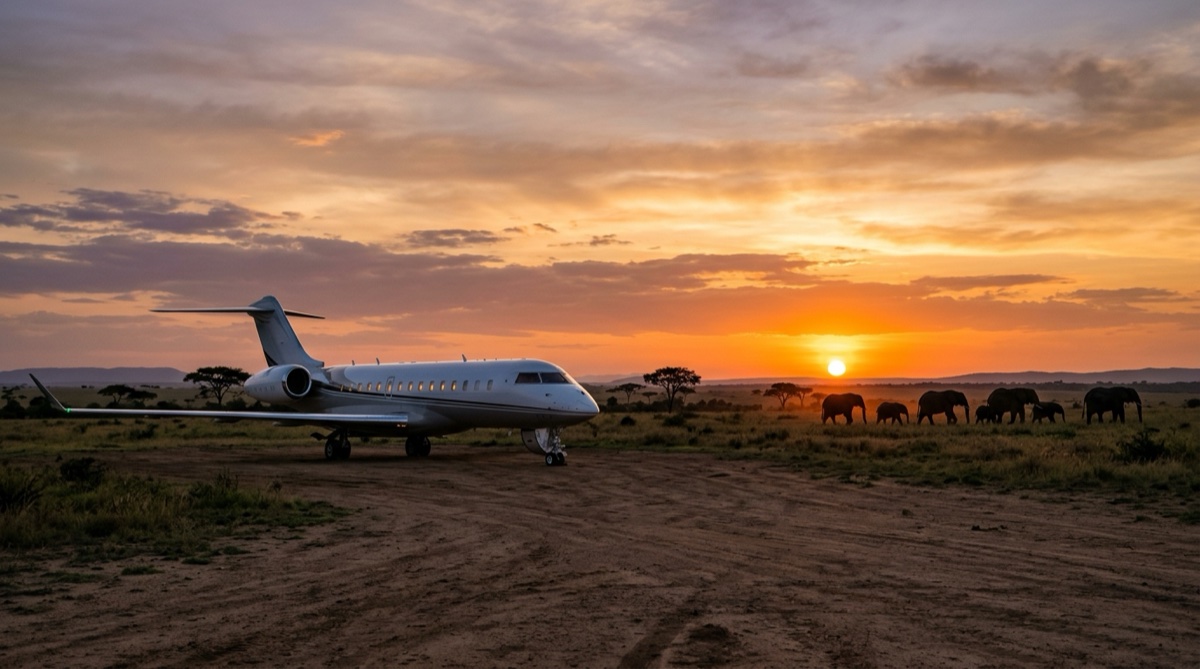
For serious travelers, the aircraft is part of the experience. Watching the Kalahari scrub give way to the Okavango’s floodplains from 10,000 feet in a jet cabin is a moment you don’t get in economy class. This guide covers everything you need to plan a private jet safari — from the intercontinental charter to the final bush hop.
Why Fly Private to African Safari Destinations
Remote Airstrips and Exclusive Bush Camps
The most coveted safari lodges in Africa are intentionally inaccessible. Botswana’s high-end policy — fewer visitors, higher prices, lower environmental impact — means camps like Mombo and Jao sit on islands in the Okavango Delta, reachable only by small charter aircraft. Kenya’s top Maasai Mara conservancy camps operate from grass airstrips shared by a handful of properties.
Commercial airlines can’t serve these strips. Even regional carriers only reach the nearest town or park headquarters. Private aviation — specifically turboprops and very light jets that handle soft-surface strips — is the only way to arrive directly.
Time Savings vs Commercial Routes
Flying commercial from New York to the Serengeti typically involves two or three connections: JFK → Amsterdam or London → Kilimanjaro or Nairobi → a bush charter. That’s often 24–36 hours of travel. On a private jet to Nairobi direct, you cut that to 16–18 hours of flight time, with zero layovers. Your first full day in Africa is a safari day, not a recovery day.
The in-country savings compound. Moving between a Serengeti camp and the Ngorongoro Crater by commercial bush charter means aligning with scheduled departure times and sharing aircraft. On a private charter, you leave at first light — golden hour — when wildlife is most active.
Flexibility Across Multiple Countries
Africa’s best safari itineraries span borders: Botswana’s Okavango into Zimbabwe’s Victoria Falls, or Kenya’s Maasai Mara into Tanzania’s Serengeti. By private jet, you cross those borders seamlessly. Your operator handles the overflight permits and customs coordination — you simply board and arrive.
A typical 10-day circuit might cover: Johannesburg (arrival) → Okavango Delta → Victoria Falls → Cape Town (departure). Commercial travelers need to fly in and out of the same hub. Private flyers design a point-to-point itinerary that moves with the wildlife calendar.
Top African Safari Destinations for Private Aviation
Botswana — The Okavango Delta ✈️
Botswana is the gold standard for private jet safaris. The Okavango Delta — a UNESCO World Heritage Site — floods seasonally, creating an extraordinary labyrinth of channels and islands. Peak season is July through October when water levels concentrate wildlife.
Key airstrips: Maun International (MUB) is the main hub. Wilderness Air operates transfers from Maun to camps throughout the Delta, including Moremi, Chief’s Island, and the Linyanti. Most strips are grass — maximum aircraft size is typically a Cessna Caravan or PC-12.
Combine with: Zimbabwe’s Hwange National Park and Victoria Falls are a short hop west, forming a classic Botswana–Zimbabwe circuit.
Kenya — Maasai Mara and Samburu
The Maasai Mara needs no introduction. The annual wildebeest migration — roughly July through October — draws millions of animals across the Mara River in one of nature’s most dramatic spectacles. Jomo Kenyatta International (NBO) in Nairobi is the main gateway, with Wilson Airport (WIL) serving domestic bush charters.
Private aviation advantage: The Mara’s top conservancy camps — Ol Seki, Mahali Mzuri, Angama — have exclusive or near-exclusive airstrip access. Arriving on your own schedule means a game drive the moment you land instead of waiting for a shared transfer.
For a less-visited gem, Samburu National Reserve in northern Kenya offers Grevy’s zebra, reticulated giraffe, and Samburu-specific species — with far fewer visitors than the Mara.
Tanzania — Serengeti and Ngorongoro
Tanzania’s northern circuit is among the world’s most visited safari areas, but with private aviation you stay one step ahead of the crowds. Kilimanjaro International (JRO) and Julius Nyerere International (DAR) handle international arrivals; Air Tanzania and private operators connect to bush strips at Seronera, Grumeti, and the crater rim.
The Ngorongoro Crater floor — a 2,000-foot-deep volcanic caldera with the highest density of large predators on earth — has only limited visitor numbers per day. Staying at the Ngorongoro Crater Lodge, perched on the rim, puts you first in the queue.
Combine with: Zanzibar. A 30-minute private flight after your final game drive gives you a beach finale on the Swahili Coast.
South Africa — Kruger, Cape Winelands, and Cape Town
South Africa is the easiest entry point for private aviation in Africa. O.R. Tambo International (JNB) in Johannesburg and Cape Town International (CPT) are world-class airports with full FBO services. South Africa also hosts the continent’s most sophisticated private jet infrastructure.
The Kruger National Park and neighboring private reserves — Sabi Sand, Singita, Timbavati — have several good-quality airstrips handling light jets. Skukuza Airport (SZK), inside the park, accepts aircraft up to midsize jet size. You can fly direct from Cape Town to Skukuza on a light jet in under two hours.
Cape Town itself — accessed from JNB in under two hours by light jet — offers the iconic Cape Winelands, Table Mountain, and some of Africa’s finest dining. A 10-day South Africa itinerary combining Sabi Sand and the Cape is the most popular private jet safari circuit on the continent.
Zimbabwe — Hwange and Victoria Falls
Victoria Falls Airport (VFA) accepts private jets up to heavy jet size. The falls themselves — straddling the Zimbabwe–Zambia border — and Hwange National Park are accessible within 45 minutes of landing. Zimbabwe also offers walking safaris and canoe trips along the Zambezi that most East African parks don’t allow.
Private Jet Route Pricing to Africa
Charter pricing for Africa varies significantly by origin, aircraft type, and season. The table below shows estimated one-way charter costs based on market rates as of early 2026.
| Route | Distance | Aircraft Type | Flight Time | Est. Charter Cost (One Way) |
|---|---|---|---|---|
| New York (JFK) → Johannesburg (JNB) | 7,870 nm | Ultra Long Range (G700, Global 7500) | ~17 hrs | $280,000–$380,000 |
| London (LCY) → Nairobi (NBO) | 3,810 nm | Heavy Jet (Global 5500, G550) | ~8.5 hrs | $90,000–$140,000 |
| London (LCY) → Cape Town (CPT) | 5,160 nm | Ultra Long Range (G700, Global 7500) | ~11 hrs | $150,000–$220,000 |
| Paris (LBG) → Nairobi (NBO) | 3,650 nm | Heavy Jet (G450, Falcon 7X) | ~8 hrs | $80,000–$125,000 |
| Dubai (DXB) → Nairobi (NBO) | 2,120 nm | Midsize / Super Midsize (Challenger 350) | ~5 hrs | $42,000–$72,000 |
| Johannesburg (JNB) → Maun (MUB) | 640 nm | Light Jet (Phenom 300E) | ~1.5 hrs | $12,000–$20,000 |
| Nairobi (WIL) → Maasai Mara (OLX) | 155 nm | Turboprop (PC-12, Caravan) | ~40 min | $3,500–$6,500 |
Prices are estimates based on market data as of April 2026. Actual costs vary by operator, route, availability, and positioning fees.
💡 Check our empty leg listings for current Africa repositioning flights — they occasionally appear on Johannesburg and Cape Town routes, offering 40–60% savings.
Best Aircraft for African Safari Travel
Heavy and Ultra Long Range Jets for Intercontinental Legs
Any flight exceeding 4,500 nautical miles — essentially anything from North America or the US East Coast into sub-Saharan Africa — requires an ultra-long-range jet. The Gulfstream G700, Bombardier Global 7500, and Dassault Falcon 10X are the aircraft of choice. They combine range with enough cabin space for a full night’s sleep on a 17-hour crossing.
From Europe, heavy jets like the Gulfstream G550 or Global 5500 can reach Nairobi and Johannesburg non-stop. These aircraft comfortably seat 12–16 passengers and offer full galley and sleeping berths for long-haul comfort.
For a deep dive on heavy jet specifications, see our guide to the best heavy jets for long-range travel.
Light Jets and Turboprops for In-Country Transfers
Once you’re on the African continent, the rules change. Bush airstrips demand short-field performance and are often unpaved. The workhorses of African safari aviation are:
- Cessna 208 Caravan — The most common bush charter aircraft. Seats 9, handles any strip, operated widely by Wilderness Air, Air Kenya, and Mack Air.
- Pilatus PC-12 — A faster, more powerful turboprop with excellent STOL performance. Comfortable for passengers, preferred for longer regional hops.
- Phenom 300E — Suitable for prepared airstrips like Skukuza and Maun. Offers jet comfort for South Africa and Botswana circuits where airstrips are paved.
Combining a heavy jet for the intercontinental crossing with turboprops or light jets for the in-country circuit gives you the best balance of performance and access.
Helicopter Charters for the Final Mile
Several top safari lodges maintain helicopter pads, and some circuits use helicopters for camp-to-camp transfers that would otherwise require a longer turboprop flight. Helicopter options add cost but deliver aerial wildlife viewing — a different and equally extraordinary perspective on the landscape.
Airport and Entry Logistics
International Gateway Airports
| Airport | IATA | Country | FBO Options | Notes |
|---|---|---|---|---|
| O.R. Tambo International | JNB | South Africa | Signature Flight Support, ExecuJet | Full FBO; best-equipped in Africa |
| Cape Town International | CPT | South Africa | NAC (National Airways Corp) | Excellent facilities, proximity to Winelands |
| Jomo Kenyatta International | NBO | Kenya | Fahari Aviation, Wilson Airport FBO | Nairobi’s main hub |
| Kilimanjaro International | JRO | Tanzania | Limited FBO; coordinate in advance | Key entry for northern circuit |
| Victoria Falls International | VFA | Zimbabwe | Small terminal; private jet handling available | Limited fuel supply — verify in advance |
Bush Airstrips and Permits
Flying into bush strips involves more coordination than arriving at an international airport. Your charter operator handles:
- Overflight permits for each country flown through (2–5 business days minimum)
- Landing permits at national park airstrips, which are often limited to daytime VFR operations
- Fuel planning — remote strips may have no fuel. Positioning from the nearest hub and returning is sometimes the only option
Always book operators with established Africa experience. Local knowledge of strip conditions, wet-season closures, and fuel availability makes the difference between a smooth itinerary and a disrupted one.
Customs, Visas, and Paperwork
Private jet arrivals in Africa follow the same entry requirements as commercial passengers. Key points:
- South Africa: Visa-free for US, UK, EU, and most Western passports
- Kenya: eTA required ($30 single entry); or East Africa Tourist Visa for Kenya + Tanzania + Uganda ($200)
- Tanzania: eTA required ($50)
- Botswana: Visa-free for US, UK, EU passport holders (up to 90 days)
- Zimbabwe: Visa on arrival ($30 single entry) or KAZA Univisa for Zimbabwe + Zambia ($50)
Your charter operator’s handling agent typically assists with customs clearance at private terminals, separating you from commercial passenger queues.
Seasonal Guide — When to Fly for Peak Wildlife
Timing your safari by destination dramatically affects what you’ll see.
| Destination | Jan–Mar | Apr–May | Jun–Aug | Sep–Oct | Nov–Dec |
|---|---|---|---|---|---|
| Okavango Delta, Botswana | Good | Excellent (green season) | Peak (dry, wildlife dense) | Peak | Good |
| Maasai Mara, Kenya | Good | Quiet (long rains) | Very good | Peak (migration) | Good |
| Serengeti, Tanzania | Good (calving) | Quiet (rains) | Very good | Peak | Good |
| Sabi Sand / Kruger, South Africa | Good (lush) | Excellent | Peak (dry) | Peak | Good |
| Victoria Falls, Zimbabwe | Good | Full falls | Good | Very good | Very good |
April and May are underrated. The green season in Botswana and South Africa brings lush landscapes, newborn animals, excellent birding, and far lower lodge rates. Crowds drop significantly — and charter aircraft availability improves, sometimes with lower positioning costs.
Frequently Asked Questions
Which African country is best for a private jet safari?
Botswana is the top choice for exclusive private jet safaris. Its high-cost, low-volume tourism model protects pristine wilderness, and the Okavango Delta’s remote camps are only accessible by small aircraft. Kenya and Tanzania are unbeatable for the wildebeest migration. South Africa offers the easiest international access and the widest range of luxury lodges — an ideal first-time Africa destination.
How much does a private jet safari to Africa cost?
The intercontinental leg is the biggest expense. A London–Nairobi charter runs $90,000–$140,000 on a heavy jet; London–Cape Town costs $150,000–$220,000 on an ultra-long-range aircraft. Once in-country, bush charter flights between camps run $3,500–$20,000 per leg. Total private jet safari budgets including lodge accommodation typically start around $200,000 for a couple over 10 days.
Can private jets land at bush airstrips in Africa?
Not directly in most cases. Most remote bush camps use grass or dirt airstrips too short and soft for jets. The standard itinerary is a heavy or ultra-long-range jet to a major gateway (Johannesburg, Nairobi, Cape Town), then a turboprop or very light jet for the bush transfers. Operators like Wilderness Air, Air Kenya, and Mack Air specialize in camp-to-camp transfers across Southern and East Africa.
What aircraft is best for flying within Africa on safari?
The Cessna 208 Caravan and Pilatus PC-12 handle almost any African bush airstrip with ease. Both seat 6–9 passengers and are certified for unpaved surfaces. For slightly longer hops with paved strips — say, Johannesburg to Maun or Nairobi to Kilimanjaro — a light jet like the Phenom 300E adds speed and comfort. See our light jet comparison for full specifications.
Is it safer to fly private to African safari destinations than commercial?
Private aviation on vetted operators is comparably safe to commercial aviation when you choose correctly. Use only IATA-accredited operators or those certified by the Air Operators Association of Southern Africa (AASA) or Kenya Civil Aviation Authority. The NBAA Business Aviation Safety Report confirms business aviation maintains strong safety records globally. In-country operators vary more — always verify your operator’s AOC before booking.
How far in advance should I book a private jet safari?
Book intercontinental charters at least 6–8 weeks ahead, ideally 3–4 months for peak safari months (July–October). In-country bush charter availability and top lodge beds go quickly during peak season. Booking your aviation and accommodation together through a specialist Africa operator often provides better access to both aircraft and lodge availability.
Are there empty leg deals on flights to Africa?
Yes, though rarer than on short-haul routes. Ultra-high-net-worth clients regularly charter jets to South Africa, Kenya, and Egypt, generating repositioning flights. Alert services publish Africa empty legs — typically saving 40–60% on the standard charter rate. Check our empty leg listings regularly and set up alerts on platforms like Victor and Air Charter Service. Flexibility on dates is essential.
Do I need a visa for a multi-country African safari by private jet?
Requirements depend on your passport and itinerary. South Africa is visa-free for US, UK, and EU passport holders. Kenya and Tanzania require an eTA or East Africa Tourist Visa ($100–$200). Botswana is visa-free for most Western passports. Zimbabwe issues visa on arrival ($30) or the KAZA Univisa for Zimbabwe and Zambia together ($50). Always verify requirements at least 60 days before departure.
The Takeaway
A private jet safari in Africa is the most transformative travel experience money can buy. You move on your timeline, arrive minutes from extraordinary wildlife, and experience landscapes most travelers never access. The combination of an ultra-long-range jet for the crossing, bush charters for the camps, and meticulous logistics planning turns a complicated journey into something effortless.
April and May are among the best months to plan your first Africa circuit. The green season brings dramatic skies, newborn wildlife, and far lower lodge rates. Charter availability is better than in peak summer months — and the Okavango Delta is at its most photogenic.
Browse our private jet directory to find Africa-experienced charter operators, or submit your safari brief directly through our contact page and we’ll connect you with the right operator for your itinerary. For more destination inspiration, explore our guide to Caribbean private jet routes or the Monaco and Cannes flying guide.
Ready to fly to Africa on your own terms?